
We have always built.
We built banks when banks would not take our money. We built insurance companies when insurers would not cover our lives. We built whole business districts, and when they were burned or bulldozed, we built again.
This report looks at three things. Where we've been. Where we stand today, in hard numbers. And where we're going.
The numbers are not all good. Some of them are hard to read. But they are real, they come from official sources, and every one is cited. We think you deserve the truth, and a plan.
Where We've Been
- 1865
Freedman's Savings Bank
On March 3, 1865, Congress chartered the Freedman's Savings Bank to help newly freed people save9. Tens of thousands did. Frederick Douglass became its last president in 1874, but it was too late. The bank had been badly run by its white trustees. When it closed in June 1874, it left 61,144 depositors with losses of nearly $3 million9. Many families never got their full savings back. That loss of trust in banks lasted for generations.
- 1906
Durham's Parrish Street, "Black Wall Street"
In Durham, North Carolina, Black-owned businesses lined a four-block stretch of Parrish Street11. North Carolina Mutual Life Insurance Company moved there in 1906, led by John Merrick, Dr. Aaron Moore and C. C. Spaulding. Mechanics and Farmers Bank was founded in 190711. Booker T. Washington visited in 1910 and praised what he saw. W. E. B. Du Bois documented it in 191211.
- 1921
Greenwood, Tulsa
Greenwood was a thriving Black district in Tulsa, often called Black Wall Street. On May 31 and June 1, 1921, a white mob destroyed it. Thirty-five city blocks were left in ruins. Oklahoma's 2001 commission estimated 1,256 homes were destroyed, and that 100 to 300 people were killed. More than 800 people were treated for injuries, and over 6,000 Black residents were detained10. Churches, schools, businesses, a hospital and a library were burned10. Greenwood rebuilt anyway.
- 1930s
Built-in gaps: New Deal housing and the GI Bill
In the 1930s, the federal government began rating neighborhoods for mortgage risk. Black neighborhoods were rated worst. Research from the Chicago Fed finds the Federal Housing Administration (FHA) did the most damage: it largely shut Black borrowers and core city neighborhoods out of federally insured loans. In Baltimore from 1935 to 1940, only 25 Black households got FHA-insured loans13. The famous HOLC "redlining maps" were real, but this research finds the FHA's own practices did more harm than the maps themselves13. After World War II, the GI Bill paid for college and helped veterans buy homes. But for Black veterans in the South, who were limited to segregated colleges, research finds the GI Bill "had little effect" on college outcomes, and it widened the gap with white veterans14.
- 1956
Sweet Auburn, Atlanta
Auburn Avenue became the center of Black business and church life in Atlanta. In 1956 Fortune magazine called it "the richest Negro street in the world"12. It was home to Citizens Trust Bank, which lent to Black homeowners and entrepreneurs that white lenders underserved12. It was named a National Historic Landmark in 197612.
- Today
Black-owned banks and the civil rights era
Black communities kept building their own financial institutions. Today the FDIC keeps an official list of minority depository institutions, including Black-owned banks23. The National Bankers Association represents many of them25. The civil rights movement opened doors to public accommodations, voting, and later, set-aside programs for government contracts. Many of today's tools, like SBA 8(a), DBE programs and minority business certification, grew out of that era.
What This History Tells Us
Two things are true at once.
Every time we were shut out, we built our own.
They came from laws, lending rules and violence, not from a lack of talent or effort. What was built can be rebuilt differently.
Where We Stand
All figures below are the most recent official data we could find and open. “Calculated” means we did the division from official totals.
Number Of Businesses Vs. Share Of The Population
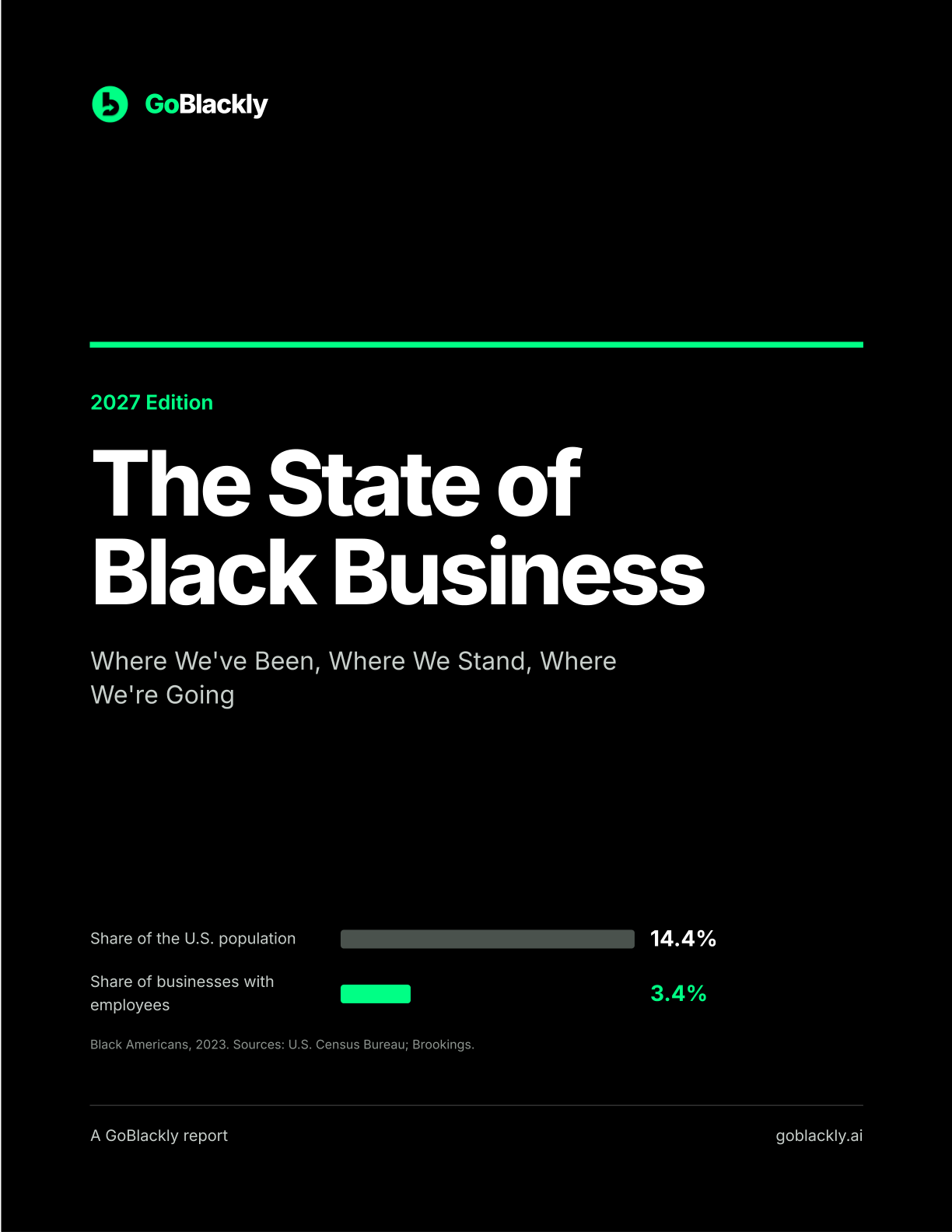
- In 2023, there were about 201,000 Black-owned employer businesses (businesses with paid employees). That is 3.4% of all U.S. employer businesses13.
- Black Americans are 14.4% of the U.S. population3.
- White-owned firms were 80.6% of employer businesses (about 4.8 million), compared to 63.4% of the population13.
Source: Brookings, Perry & Stephens, March 2026, using Census ABS 2024 (reference year 2023). 3
- The good news: Black-owned employer businesses grew 62% from 2017 to 2023, adding nearly 77,000 firms. All employer businesses grew just 3.3% in that time3. Growth slowed to 3.2% from 2022 to 2023, after a jump of about 21% the year before3.
- Black women are leading growth. Black women–owned employer businesses grew 78% from 2017 to 2023, to about 79,000 firms3.
Revenue And Jobs
- Black-owned employer businesses earned $249.0 billion in revenue in 20231.
- They employed over 1.8 million people and paid $69.8 billion in salaries3.
- Average revenue per Black-owned employer firm: about $1.24 million (calculated: $249.0B ÷ 201,000)1.
- Average revenue per white-owned employer firm: about $3.54 million (calculated: $17.0T ÷ 4.8M)1.
Source: Calculated from Census totals; counts rounded. 1
Counts in the source are rounded, so these averages are approximate.
Businesses With No Employees
- In 2022, there were 4.4 million Black-owned nonemployer businesses, 14.9% of all nonemployer businesses, roughly matching our share of the population4.
- They earned $130.9 billion in total4. That's about $29,750 per business (calculated).
- White-owned nonemployer businesses averaged about $59,360 (calculated: $1.3T ÷ 21.9M)4.
Source: Census Nonemployer Statistics by Demographics, May 2025 release. Averages calculated. 4
What this means: we are starting businesses at our share of the population. The gap is in growing them into businesses with employees and bigger revenue.
Applying For Loans And Getting Approved
From the Federal Reserve's Small Business Credit Survey (employer firms, financing sought in the prior 12 months)5678. Plain reading: Black-owned businesses apply for loans more often, and get fully approved far less often. In 2025, 32% of Black-owned applicants got the full amount they asked for, compared to 57% of white-owned applicants56.
| Year | Black-owned | White-owned |
|---|---|---|
| 2016 | 28% | 58% |
| 2017 | 30% | 60% |
| 2018 | 38% | 61% |
| 2019 | 34% | 66% |
| 2020 | 25% | 53% |
| 2021 | 25% | 50% |
| 2022 | 20% | 58% |
| 2023 | 32% | 56% |
| 2024 | 35% | 56% |
| 2025 | 32% | 57% |
Sources: Share of applicants. Federal Reserve Small Business Credit Survey via FRED. 56
"Approved for the full amount" covers loans, lines of credit and merchant cash advances; pandemic aid is excluded. The Fed notes the survey is not a random sample [5].
Other signs from the Fed's surveys
- In 2021, 50% of Black-owned firms reported trouble getting credit, compared to 28% of white-owned firms15.
- In 2021, among firms that did not apply for pandemic aid, 67% of Black-owned firms said it was because they didn't think they'd qualify (43% of white-owned)15.
- In 2022, 51% of Black-owned firms named credit availability as a financial challenge, compared to about a quarter of white-owned firms16.
Startup Capital
The Wealth Gap
Source: Federal Reserve, FEDS Notes, Oct. 2023 (Survey of Consumer Finances 2022). 17
Why it matters for business: most small businesses are started with the owner's own money, family money, or a loan backed by a home. Less wealth means less starting capital and less to fall back on.
Online And Digital
Source: Pew Research Center, Jan. 2024. 18
We could find no credible official data on websites, Google profiles or online sales by business owner race. We'd rather say that plainly than use a made-up number.
Why The Gap Exists
- Capital
- Most businesses start with the owner's money. When the typical Black family has about 15 cents for every dollar a white family has17, Black founders start with less and have less cushion when things go wrong.
- Credit
- Black-owned businesses apply for loans more often, but are much less likely to get the full amount56. Many don't apply at all because they expect to be turned down15. A thin or missing business credit file makes this worse.
- Networks
- Contracts, referrals and investors often move through who you know. Generations of segregation in neighborhoods, schools and industries left many Black owners outside the rooms where deals happen.
- Generational Wealth
- Wealth passes down. Homes, savings and family businesses that were burned (Greenwood), drained (Freedman's Bank) or never allowed (FHA lending) never got passed down91013.
- The Digital Divide
- Today, customers find businesses online first. Fewer Black households have home broadband18, and many small businesses still run on phone calls and paper. That makes it harder to be found, follow up with leads and get paid fast.
None of these are about talent or work ethic. They are about access.
What's Working
Janice Bryant Howroyd
ActOne Group, staffing
She started her staffing company in 1978 in a small Beverly Hills office with $1,500 of her own, plus money borrowed from her mother and brother20. She grew it into a global workforce company and is recognized as the first Black woman to build and own a billion-dollar company20.
Lesson: Start small, serve real business customers, and keep reinvesting.
Daymond John
FUBU, apparel
He started with about $40 of fabric, sewing hats and selling them on a street corner in Queens21. When he needed money to fill big orders, 27 banks turned him down. He and his mother took out a second mortgage on their home to keep the business alive21. FUBU became a global brand.
Lesson: Black founders often had to fund growth with family assets because banks said no. That's the capital gap, in one story.
Melissa Butler
The Lip Bar, beauty, Detroit
She pitched The Lip Bar on Shark Tank and walked away without a deal22. She kept going, and her products were picked up by Target22.
Lesson: "No" is not the end. Retail-ready products, a strong brand and an online audience can open doors.
Where Do You Stand?
Twelve quick questions about your business. You'll get a score out of 100, a plain result for each gap in this report, and where to go next.
- 12 questions
- About 2 minutes
- 5 gap areas
This is a quick self-check, not a credit score or financial advice.
Resources Toolkit
Last checked: November 2026. Programs open and close; check each site for current dates and rules. Links open in a new tab.
Grants And Funds
- Grants.gov
The official search for federal grants (mostly for nonprofits and research; few for-profit small business grants).
Nationwide - SBIR / STTR
Federal research funding for small businesses building new technology.
Nationwide - FedEx Small Business Grant
Yearly grant contest for small businesses. Check dates; contests run on a schedule.
Nationwide - Amber Grant
Monthly grants for women-owned businesses.
Nationwide - IFundWomen
Grants and crowdfunding for women-owned businesses.
Nationwide - Hello Alice Grants
A list of open small business grants.
Nationwide - Comcast Project UP
Comcast's small business support (the old Comcast RISE link now goes here). Check the page for what's open.
Nationwide
CDFIs And Black-Owned Banks
- FDIC Minority Depository Institutions List
The official list of minority-owned banks, including Black-owned banks. Filter by "Black or African American."
Nationwide list; banks are local or regional - FDIC MDI Program
Background on minority-owned banks.
- CDFI Fund (U.S. Treasury)
Certifies Community Development Financial Institutions, lenders focused on underserved communities.
Nationwide - Opportunity Finance Network CDFI Locator
Find a CDFI lender near you.
Local results - National Bankers Association
Trade group for minority-owned banks.
Nationwide
SBA Programs, SBDCs And Contracting Help
- SBA Loans
Overview of SBA-backed loans (7(a), 504, microloans), made through local lenders.
Nationwide - SBA Certifications, Including 8(a)
SBA's contracting certifications, including 8(a) and HUBZone. Check SBA's current eligibility rules before you apply.
Nationwide - Free Local Help (SBDCs, SCORE, Women's Business Centers)
Find SBA's free resource partners near you.
Local offices, nationwide network - SCORE
Free business mentoring.
Nationwide and local chapters - MBDA (Minority Business Development Agency)
Federal agency for minority business growth. Check the site for what's offered today.
- APEX Accelerators
Free help getting ready for government contracts (formerly PTACs).
Local centers, nationwide
MBE Certification And Government Contracting Basics
- NMSDC
National certification for minority business enterprises (MBEs) for corporate supply chains, done through regional councils.
Nationwide, via local councils - DOT Disadvantaged Business Enterprise (DBE)
Certification for transportation-funded contracts, done through your state. In October 2025 the U.S. Department of Transportation issued an interim final rule that changed how DBE eligibility is decided, and current DBEs are being re-evaluated24. Check your state's program for the current rules.
State-run - SAM.gov
Required registration to do business with the federal government; gives you a Unique Entity ID.
Nationwide, free - IRS EIN
Get a free federal Employer Identification Number.
Nationwide, free
Business Credit Basics
- Dun & Bradstreet D-U-N-S Number
A free business ID many lenders, suppliers and corporations use to look up your business credit.
Nationwide - Experian Business
Check your business credit report.
- Equifax Business
Business credit reports and scores.
Black Chambers And Networks
- U.S. Black Chambers, Inc.
National network of Black chambers of commerce.
Nationwide, with local member chambers - National Black Chamber of Commerce
National advocacy and network for Black-owned businesses.
Nationwide - NAACP
Includes economic programs and resources.
Nationwide, local branches
Where We're Going
We built GoBlackly because the gaps in this report are real, and many of them can be worked on, one business at a time. Here is how each gap maps to what we offer. We can't promise funding or results. We can give you the tools and the support.
- Credit and capitalFewer full approvals, thin credit filesCredit HubBuild and track your business credit file, with guided steps and net-30 accounts.
- ContractsHard to break into government and corporate workGovernment ContractingStep-by-step guidance on registrations, certifications and bids.
- The digital divideHard to be found online and follow upWebsites and Onyx, our AI assistantBuilt around Traffic, Leads, Customers: get found, capture leads, follow up, and book.
- NetworksShut out of the rooms where deals happenUnityOur community, plus social posting tools to stay visible.
- Cash flowSlow payments, paper invoicesPayments and InvoicesSend invoices and get paid inside one platform.
Build What Comes Next With Us
Where we're going depends on what we build next. If you want help building yours, start with a free 15-minute call.
GoBlackly does not lend money and cannot guarantee credit approval, funding, contracts or revenue.
Get The PDF
The full report as a designed PDF: every chart, every source, and the resources toolkit. Free.
Sources
- U.S. Census Bureau, "Census Bureau Releases New Data on Business Owner Characteristics" (2024 Annual Business Survey, reference year 2023), Nov. 20, 2025. census.gov
- Pew Research Center, "A look at Black-owned businesses in the U.S.," Feb. 12, 2025 (2023 ABS, reference year 2022). pewresearch.org
- Brookings, Andre M. Perry & Hannah Stephens, "Black employers are reaching new heights," Mar. 10, 2026. brookings.edu
- U.S. Census Bureau, Nonemployer Statistics by Demographics release (reference year 2022), May 8, 2025. census.gov
- Federal Reserve Small Business Credit Survey via FRED, "Approved for New Financing: Black or African American-Owned Employer Firms" (SBCSS3B1V2FRB). fred.stlouisfed.org
- Federal Reserve Small Business Credit Survey via FRED, "Approved for New Financing: White-Owned Employer Firms" (SBCSS3B1V1FRB). fred.stlouisfed.org
- Federal Reserve Small Business Credit Survey via FRED, "Applied for New Financing: Black or African American-Owned Employer Firms" (SBCSS2B1V2FRB). fred.stlouisfed.org
- Federal Reserve Small Business Credit Survey via FRED, "Applied for New Financing: White-Owned Employer Firms" (SBCSS2B1V1FRB). fred.stlouisfed.org
- Office of the Comptroller of the Currency, "Freedman's Savings Bank." occ.gov
- Tulsa Historical Society & Museum, "1921 Tulsa Race Massacre." tulsahistory.org
- N.C. Dept. of Natural and Cultural Resources, "Black Wall Street (G-116)" historical marker, Dec. 20, 2023. dncr.nc.gov
- New Georgia Encyclopedia, "Auburn Avenue (Sweet Auburn)." georgiaencyclopedia.org
- Federal Reserve Bank of Chicago, Jonathan Rose, policy brief on federal housing programs and redlining, April 2022. chicagofed.org
- NBER Working Paper 9044, Sarah E. Turner & John Bound, "Closing the Gap or Widening the Divide: The Effects of the G.I. Bill and World War II on the Educational Outcomes of Black Americans," 2002. nber.org
- Federal Reserve (Fed Communities), "Surveys highlight Black-owned small businesses' credit access challenges," Aug. 3, 2022. fedcommunities.org
- Federal Reserve (Fed Communities), Lucas Misera, "SBCS findings: startup funding challenges for people of color," July 10, 2023. fedcommunities.org
- Federal Reserve Board, FEDS Notes, "Greater Wealth, Greater Uncertainty: Changes in Racial Inequality in the Survey of Consumer Finances," Oct. 18, 2023. federalreserve.gov
- Pew Research Center, "Americans' Use of Mobile Technology and Home Broadband," Jan. 31, 2024. pewresearch.org
- Federal Reserve Small Business Credit Survey via FRED, "Increased Revenue: Black or African American-Owned Employer Firms" (SBCSS8B1V2FRB). fred.stlouisfed.org
- Black Enterprise, "With $1500 in Cash Janice Bryant Howroyd Became First Black Woman to Own a Billion-Dollar Company." blackenterprise.com
- CNBC, "How FUBU Founder Daymond John Conquered Urban Fashion," Aug. 7, 2012. cnbc.com
- Michigan Public, "From Shark Tank reject to big box success," Mar. 12, 2018. michiganpublic.org
- FDIC, Minority Depository Institutions list. fdic.gov
- Federal Register, U.S. DOT, Disadvantaged Business Enterprise Program interim final rule, Oct. 3, 2025. federalregister.gov
- National Bankers Association. nationalbankers.org